5G NR Technology Development & Lynwave Antenna Solutions
-------------------------------
Core Features Of 5G NR
-
Scalable OFDM Waveform
5G NR uses CP-OFDM (Cyclic Prefix Orthogonal Frequency Division Multiplexing) for both uplink and downlink. It supports multiple subcarrier spacing (SCS) configurations, making it flexible for a wide range of deployments across Sub-6GHz frequency bands.
-
High-Order Modulation & Massive MIMO
Advanced modulation schemes like 512-QAM and 1024-QAM, combined with large-scale antenna arrays (up to 256 elements), enable 3D beamforming and spatial multiplexing. This improves spectrum efficiency by 5 to 10 times compared to traditional systems.
-
Flexible Bandwidth
5G NR supports up to 100MHz per carrier in FR1 and up to 400MHz in FR2. With carrier aggregation, FR1 can reach 300MHz total bandwidth, and FR2 can support up to 1GHz. This bandwidth flexibility supports a variety of use cases from low-power IoT to high-speed broadband.
The Three Main Use Cases Of 5G NR

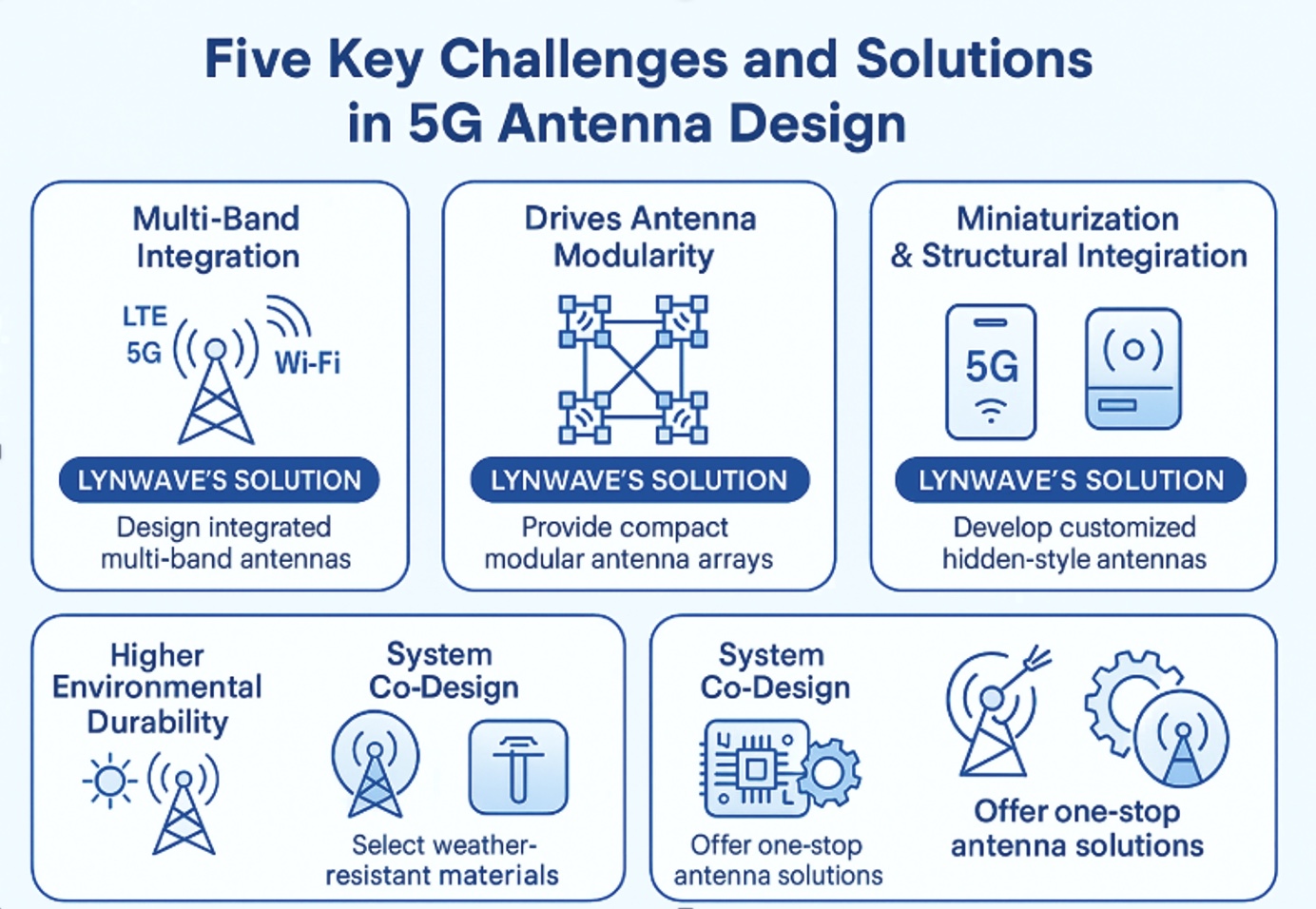
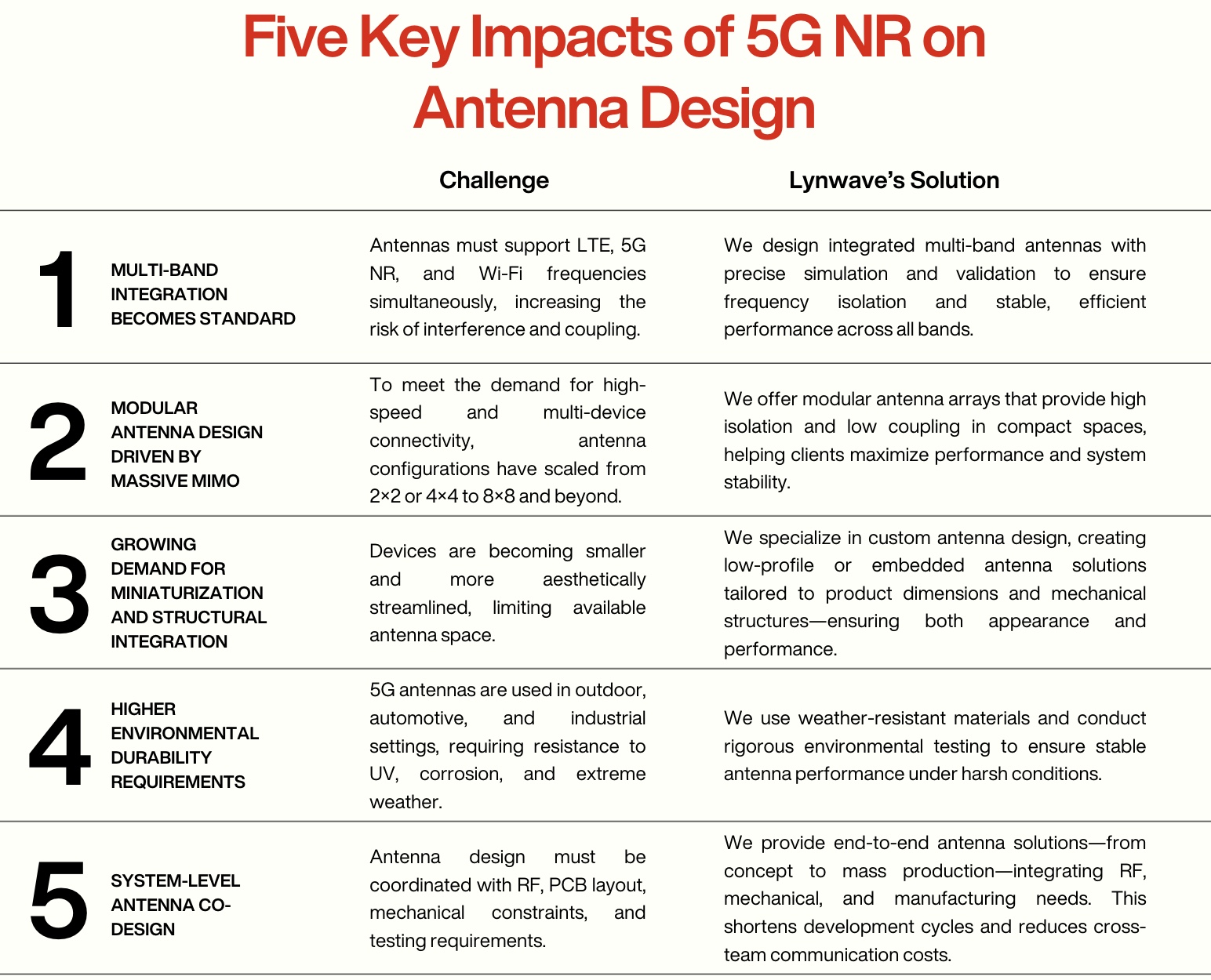
Five Key Impacts Of 5G NR On Antenna Design
Conclusion: 5G NR Drives The Next Generation Of Antenna Innovation
As 5G NR technology evolves, antenna design faces unprecedented challenges—from multi-band integration and massive MIMO scaling to extreme miniaturization and environmental resilience. Success now requires more than just performance; it demands a system-level co-design that integrates RF, mechanical, and PCB constraints.
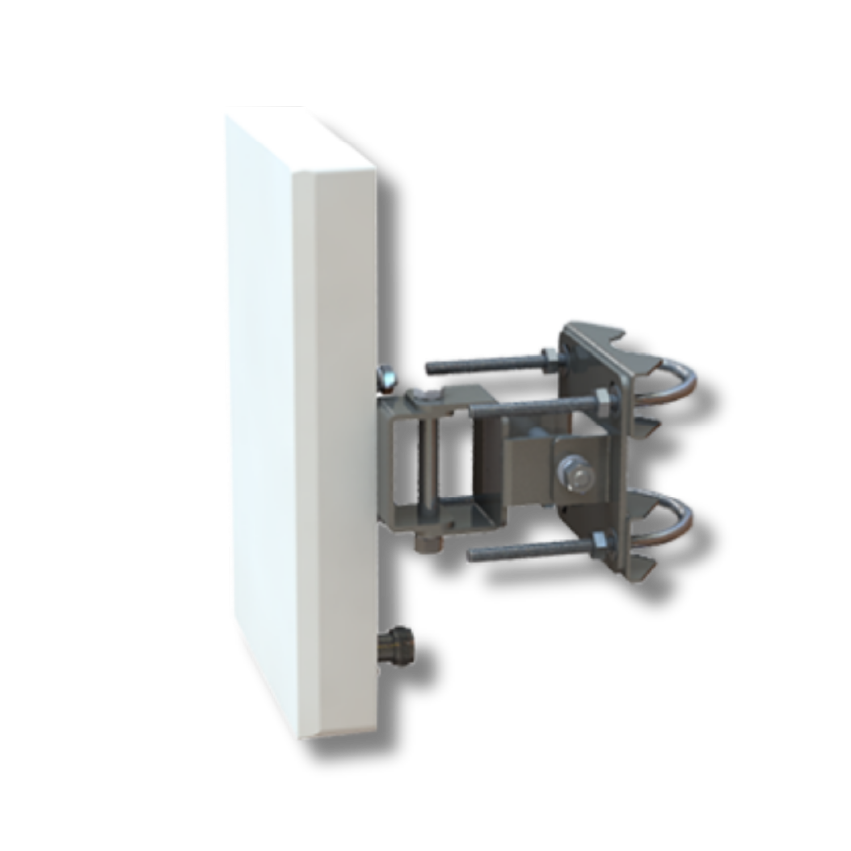
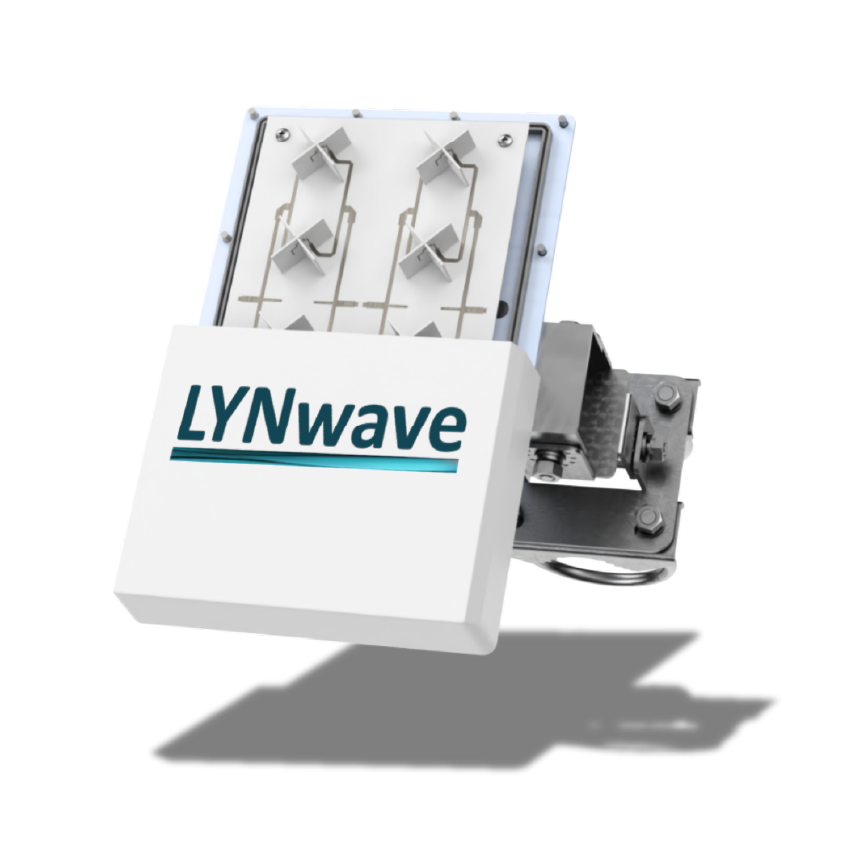
Lynwave's Integrated Solutions:
- High-Performance Arrays: Modular designs with high isolation and low coupling for 8×8 MIMO and beyond.
- Custom Miniaturization: Low-profile, embedded antennas tailored to complex mechanical structures.
- Robust Durability: Weather-resistant solutions engineered for harsh industrial and automotive environments.
- Streamlined Development: End-to-end services from simulation to mass production, significantly shortening your time-to-market.
If you're seeking a professional and reliable partner for 5G NR antenna solutions, Lynwave Technology is ready to support your 5G product roadmap.[Contact Us] to explore tailored 5G NR antenna solutions for your next innovation.